What
in the world is a polar
vortex? On Earth, it’s a large area of low pressure and extremely cold
air that usually swirls over the Arctic, with strong counter-clockwise winds
that trap the cold around the Pole. But disturbances in the jet stream and the
intrusion of warmer mid-latitude air masses can disturb this polar vortex and
make it unstable, sending Arctic air south into middle latitudes.
That
has been the case in late January 2019 as frigid weather moves across the
Midwest and Northern Plains of the United States, as well as interior Canada. Forecasters
are predicting that air temperatures in parts of the continental United States
will drop to their lowest levels since at least 1994, with the potential to
break all-time record lows for January 30 and 31. With clear skies, steady
winds, and snow cover on the ground, as many as 90 million Americans could
experience temperatures at or below 0 degrees Fahrenheit (-18° Celsius),
according to the National Weather Service (NWS).
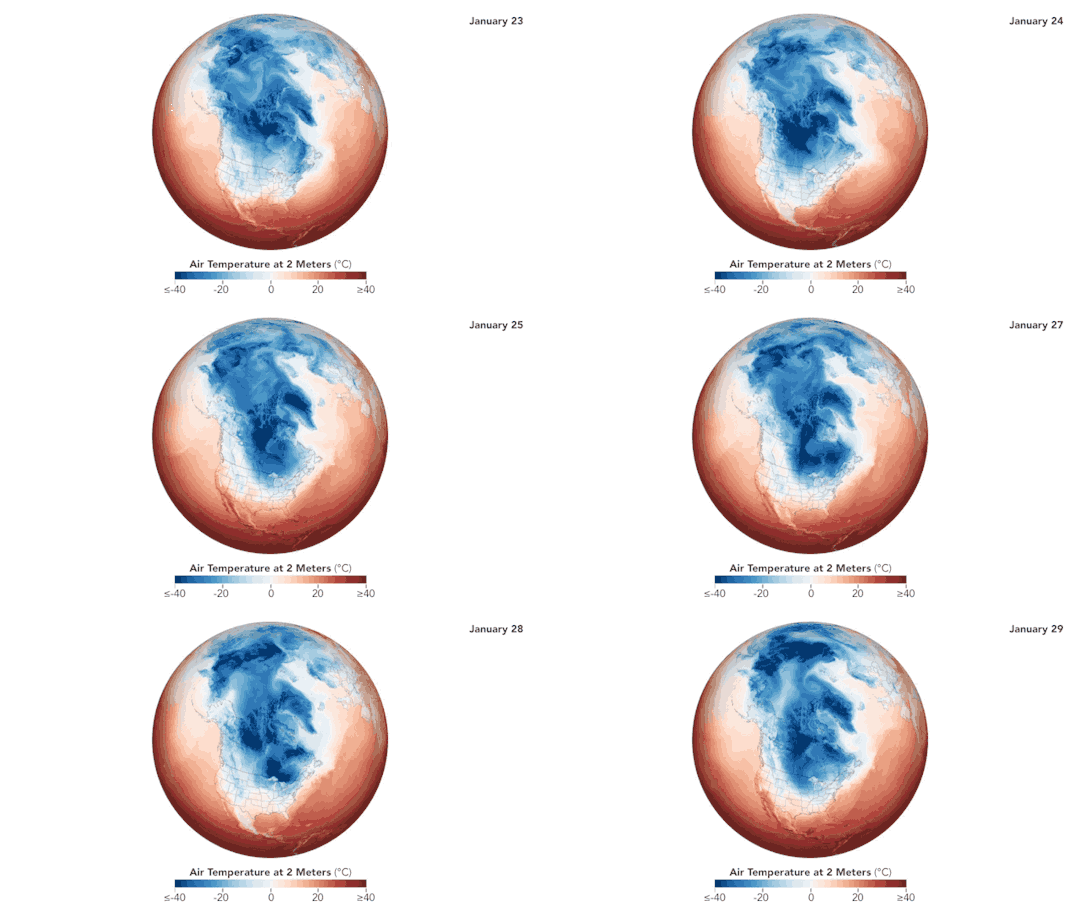
The Goddard
Earth Observing System Model above shows this air temperature
movement at 2 meters (around 6.5 feet above the ground) from January 23-29. You
can see some portions of the Arctic are close to the freezing
point—significantly warmer than usual for the dark of mid-winter—while masses
of cooler air plunge toward the interior of North America.
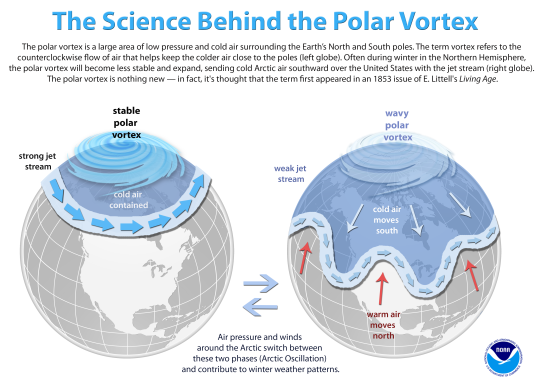
Science Behind the Polar
Vortex / Credit: NOAA
Meteorologists predicted that steady northwest winds (10 to 20 miles per hour)
were likely to add to the misery, causing dangerous wind chills below -40°F
(-40°C) in portions of 12 states. A wind chill of -20°F can cause frostbite in
as little as 30 minutes, according to the weather service.
Not sure how cold
that is? Check out the low temperatures on January 30, 2019 in some of the
coldest places on Earth—and
a planetary neighbor:
-46°F (-43°C) – Chesterfield,
Newfoundland
-36°F (-33°C) – Yukon
Territory, Canada
-33°F (-27°C) – Fargo,
North Dakota (Within the Polar Vortex)
-28°F (-18°C) –
Minneapolis, Minnesota (Within the Polar
Vortex)
-27°F (-33°C) – Amundsen-Scott
South Pole Station, Antarctica
-24°F (-31°C) – Chicago,
Illinois (Within the Polar Vortex)
-15°F (5°C) – Barrow,
Alaska
-99°F (-73°C) – Mars
Learn more about the science behind the polar
vortex and how NASA is modeling it here:
https://go.nasa.gov/2Wtmb43.
Make sure to follow us on Tumblr for your regular dose of space: http://nasa.tumblr.com


Комментариев нет:
Отправить комментарий