Search This Blog

Показаны сообщения с ярлыком Archeology. Показать все сообщения

четверг, 27 января 2022 г.

Берестяная грамота №292, финские языки, 11 век

 Надпись на берестяной грамоте 11 века, найденной в Новгороде (приб.-фин., на кириллице):


юмолануолиінимижи

ноулисъхянолиомобоу

юмоласоудьнииохови


1.Jumola nuolin imizhi
EST: Jumal noolnud inimesi
ENG: God arrowed people
RUS: Господь пронзил стрелами людей ( = обучил, научил людей слову, речи)*.

2. noulise han oli omo bou
EST: noolja, ta oli oma poeg
ENG: Arrow-shooter, he was His son
RUS: Стрельцом ("метателем стрел") был Его Сын.

3. Jumola soudin iiohovi
EST: Jumal sõudnud iia-hoovi
ENG: God rowed to the eternal yard (heaven)
RUS: И отбыл Господь на небеса (досл., "священный двор")

Автор расшифровки Андрес Пяябо - декриптовавший также бесчисленное множество венетских рунических надписей :
http://paabo.ca/papers/pdfcontents.html
http://paabo.ca//veneti/VENETILANG2014.pdf

вторник, 21 июля 2020 г.

Комета Comet C/2020 F3 (NEOWISE) 13 July 2020

Comet C/2020 F3 (NEOWISE) on 13 July 2020

Live video from night vision device The recently discovered comet which is called C/2020 or NEOWISE will be making its closest approach to planet Earth on July 22. Dawn comet viewing will be best through about July 18th, with the evening apparition starting about July 12th and continuing the remainder of the summer. Between July 12–18 you can observe it at both dusk and dawn. I had to wait until 22:00 to notice the comet, it is already visible at three times magnification, a strong wind was blowing and the tripod shook a little.
https://rumble.com/embed/v73b6v/?pub=lnfr

Комета 2020

Comet C/2020 F3 (NEOWISE) is far to the north on the sky’s dome, visible now (with optical aid) in the early evening skies. Moon and Venus beautiful before sunrise July 18.
https://rumble.com/embed/v756i7/?pub=lnfr
Луна Венера и комета Неовайз ф3 утром 18 июля 2020 Comet, Moon and Venus on evening.


пятница, 15 мая 2020 г.

Early humans in China innovated technology to adapt to climate change 1-million years ago


To assess the degree to which early stone tool using hominins modified their tool manufacturing behaviours in Eastern Asia, Shixia Yang and colleagues examined three well-known archaeological sites from the Nihewan Basin in North China. Stone tool comparisons between the archaeological sites of Xiaochangliang, Cenjiawan and Donggutuo indicate that technological skills increase at ca. 1.1-1.0 million years ago. The stone tools at Cenjiawan and Donggutuo show increasing levels of control in manufacturing procedures and some degree of planning in the tool-making process to produce desired end-products.

Early humans in China innovated technology to adapt to climate change 1-million years ago
Ecological, biological and stone tool information from 2.2 million years ago to the present (the light red horizontal bar
 shows increased climate variability) (a) Global climate change. (b) Vegetation history of the North China Plain
based on pollen analysis. (c) Hominin brain size estimates for Africa and Eurasia. (d1) Stone tool changes
 through time in the Nihewan Basin, China, showing the frequency of artefacts across different
time periods (dark green bars). (¬d2) Key stone tool changes across China
[Credit: Science China Press]


The technological innovations at ca. 1.1-1.0 million years ago in the Nihewan Basin correspond with a major climate transition which occurred between 1.2 million years ago to 700,000 years ago (called the Mid-Pleistocene Climate Transition). A series of global and regional palaeoclimatic and palaeoenvironmental changes occurred during this period, such as increases in aridity and monsoonal intensity and decreases in sea surface temperatures in the North Atlantic.


At 1.1 million years ago the early human inhabitants of the Nihewan Basin lived under a changeable and unstable environment, experiencing strengthened aridification. As climatic variability produced ecological changes, including landscape alterations and mammalian extinctions, novel technological innovations likely provided benefits to early hominin populations in the Nihewan Basin. 

The unstable environmental conditions at the onset of this period provides a good example of the adaptive versatility of hominins in China, contrasting with the notion of long-lasting conservative behaviours described by other archaeologists. Yet, the increasingly harsh and oscillating climatic conditions of this period likely undermined sustained population in North China, illustrating that technological and cultural solutions did not always overcome environmental challenges.

The study is published in the National Science Review.


* This article was originally published here

среда, 13 мая 2020 г.

Researchers trace evolution of self-control


Human self-control evolved in our early ancestors, becoming particularly evident around 500,000 years ago when they developed the skills to make sophisticated tools, a new study suggests.

Researchers trace evolution of self-control
A handaxe unearthed in Boxgrove [Credit: University of York]

While early hominins such as Homo erectus could craft basic handaxes as early as 1.8 million years ago, our hominin ancestors began to create more elaborate and carefully designed versions of these tools sometime before 500,000 years ago.

The authors of the study, from the University of York, say these advances in craftsmanship suggest individuals at this time possessed characteristics which demonstrate significant self-control, such as concentration and frustration tolerance.

The study highlights a collection of 500,000 year-old flint axes unearthed from a gravel quarry in the village of Boxgrove in West Sussex. The axes are highly symmetrical suggesting careful workmanship and the forgoing of immediate needs for longer term aims.

Senior author of the study, Dr Penny Spikins, from the Department of Archaeology said: "More sophisticated tools like the Boxgrove handaxes start to appear around the same time as our hominin ancestors were developing much bigger brains.


"The axes demonstrate characteristics that can be related to self-control such as the investment of time and energy in something that does not produce an immediate reward, forward planning and a level of frustration tolerance for completing a painstaking task.

"In the present day our capacity for self-control has become particularly important. Without the advanced levels of self-control we possess as a species, lockdown would be impossible. It takes self-control to put the needs of the community first rather than focus on our own immediate ends. Our study offers some clues as to where in human history this ability originated."

The researchers also point to evidence that the production of highly symmetrical and elaborate axes would have required knowledge and skill accumulated over a life time.

In one study, it took people trying to replicate the axes discovered at Boxgrove 16 hours of practice to even produce a recognisable handaxe.


Lead author of the study, James Green, a PhD student in the Department of archaeology at the University of York, added: "By deciphering the mental and physical processes involved in the production of prehistoric artefacts, we can gain valuable insights into the abilities of the individuals who made them.

"These axes demonstrate social learning and effortful activity directed at honing skills. They also provide some of the earliest evidence of something being deliberately made in a sequence from a picture in someone's mind.

"Self-control is not unique to humans, but may have played an important role in our evolution. It's key to many of the traits which define modern humans such as pro-sociality, cooperation and caring for the vulnerable."


* This article was originally published here

понедельник, 11 мая 2020 г.

Oldest Upper Palaeolithic Homo sapiens in Europe found in Bulgarian Cave


Two studies report new Homo sapiens fossils from the site of Bacho Kiro Cave in Bulgaria. "The Bacho Kiro Cave site provides evidence for the first dispersal of H. sapiens across the mid-latitudes of Eurasia. Pioneer groups brought new behaviours into Europe and interacted with local Neanderthals. This early wave largely predates that which led to their final extinction in western Europe 8,000 years later", says Jean-Jacques Hublin, director at the Max Planck Institute for Evolutionary Anthropology in Leipzig, Germany.

Oldest Upper Palaeolithic Homo sapiens in Europe found in Bulgarian Cave
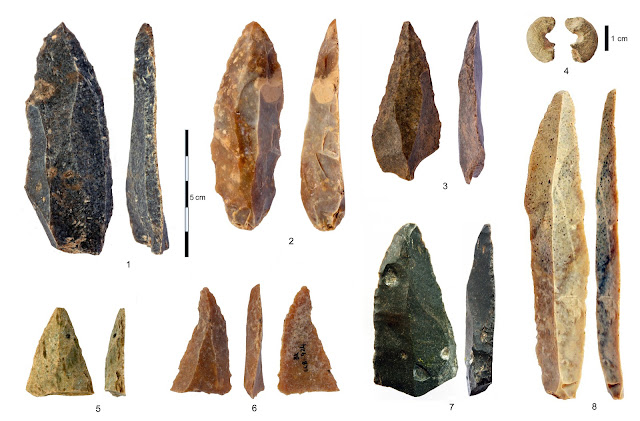
Stone artifacts from the Initial Upper Paleolithic at Bacho Kiro Cave. 1-3, 5-7: Pointed blades and fragments
 from Layer I; 4: Sandstone bead with morphology similar to bone beads; 8: The longest
 complete blade [Credit: Tsenka Tsanova, MPI-EVA Leipzig]


An international research team, led by Jean-Jacques Hublin, Tsenka Tsanova and Shannon McPherron of the Max Planck Institute for Evolutionary Anthropology, and Nikolay Sirakov and Svoboda Sirakova of the National Institute of Archaeology with Museum at the Bulgarian Academy of Sciences in Sofia, Bulgaria, renewed excavations at Bacho Kiro Cave in 2015. The most spectacular finds come from a rich, dark layer near the base of the deposits. Here the team uncovered thousands of animal bones, stone and bone tools, beads and pendants and the remains of five human fossils.


Protein analysis

Except for one human tooth, the human fossils were too fragmented to be recognized by their appearance. Instead, they were identified by analysing their protein sequences. "Most Pleistocene bones are so fragmented that by eye, one cannot tell which species of animal they represent. However, the proteins differ slightly in their amino acid sequence from species to species. By using protein mass spectrometry, we can therefore quickly identify those bone specimens that represent otherwise unrecognizable human bones", says Frido Welker, Postdoctoral Research Fellow at the University of Copenhagen and research associate at the Max Planck Institute for Evolutionary Anthropology.

Oldest Upper Palaeolithic Homo sapiens in Europe found in Bulgarian Cave
Excavations in Initial Upper Paleolithic Layer I at Bacho Kiro Cave (Bulgaria). Four Homo sapiens bones
were recovered from this layer along with a rich stone tool assemblage, animal bones, bone tools,
and pendants [Credit: Tsenka Tsanova]


To know the age of these fossils and the deposits at Bacho Kiro Cave, the team worked closely with Lukas Wacker at ETH Zurich, Switzerland, using an accelerator mass spectrometer to produce ages with higher precision than normal and to directly date the human bones.

"The majority of animal bones we dated from this distinctive, dark layer have signs of human impacts on the bone surfaces, such as butchery marks, which, along with the direct dates of human bones, provides us with a really clear chronological picture of when Homo sapiens first occupied this cave, in the interval from 45,820 to 43,650 years ago, and potentially as early as 46,940 years ago", says Helen Fewlass of the Max Planck Institute for Evolutionary Anthropology. "The radiocarbon dates at Bacho Kiro Cave are not only the largest dataset of a single Palaeolithic site ever made by a research team, but also are the most precise in terms of error ranges", say researchers Sahra Talamo from the University of Bologna and Bernd Kromer from the Max Planck Institute in Leipzig.


DNA sequencing

Though some researchers have suggested that Homo sapiens may have already occasionally entered Europe by this time, finds of this age are typically attributed to Neanderthals. To know which group of humans were present at Bacho Kiro Cave, Mateja Hajdinjak and Matthias Meyer of the genetics team led by Svante Pääbo at the Department of Evolutionary Genetics at the Max Planck Institute for Evolutionary Anthropology sequenced the DNA from the fragmented fossils bones.

"Given the exceptionally good DNA preservation in the molar and the hominin fragments identified by protein mass spectrometry, we were able to reconstruct full mitochondrial genomes from six out of seven specimens and attribute the recovered mitochondrial DNA sequences from all seven specimens to modern humans. Interestingly, when relating these mtDNAs to those of other ancient and modern humans, the mtDNA sequences from Layer I fall close to the base of three main macrohaplogroups of present-day people living outside of Sub-Saharan Africa. Furthermore, their genetic dates align almost perfectly with those obtained by radiocarbon", says Mateja Hajdinjak, Postdoctoral Fellow at the Francis Crick Institute in London and research associate at the Max Planck Institute for Evolutionary Anthropology.

Oldest Upper Palaeolithic Homo sapiens in Europe found in Bulgarian Cave
The molar found in the cave of Bacho Kiro are said to be around 45,000 years old
[Credit: Rosen Spasov]

The results demonstrate that Homo sapiens entered Europe and began impacting Neanderthals by around 45,000 years ago and likely even earlier. They brought into Bacho Kiro Cave high quality flint from sources up to 180 km from the site which they worked into tools like pointed blades perhaps to hunt and very likely to butcher the remains of the animals found at the site.

"The animal remains from the site illustrate a mix of cold and warm adapted species, with bison and red deer most frequent", says palaeontologist Rosen Spasov from the New Bulgarian University. These were butchered extensively but were also used as a raw material source. "The most remarkable aspect of the faunal assemblage is the extensive collection of bone tools and personal ornaments", says zooarchaeologist Geoff Smith from the Max Planck Institute for Evolutionary Anthropology. Cave bear teeth were made into pendants, some of which are strikingly similar to ornaments later made by Neanderthals in western Europe.


Homo sapiens replaced Neanderthals

Taken together, the Bacho Kiro Cave sediments document the period of time in Europe when Middle Paleolithic Neanderthals were replaced by Upper Paleolithic Homo sapiens (the so-called transition period), and the first Homo sapiens assemblages are what archaeologists call the Initial Upper Paleolithic. "Up to now, the Aurignacian was thought of as the start of the Upper Paleolithic in Europe, but the Initial Upper Paleolithic of Bacho Kiro Cave adds to other sites in western Eurasia where there is an even older presence of Homo sapiens", notes Nikolay Sirakov of the National Institute of Archaeology with Museum at the Bulgarian Academy of Sciences.

"The Initial Upper Paleolithic in Bacho Kiro Cave is the earliest known Upper Palaeolithic in Europe. It represents a new way of making stone tools and new sets of behaviour including manufacturing personal ornaments that are a departure from what we know of Neanderthals up to this time", says Tsenka Tsanova of the Department of Human Evolution at the Max Planck Institute for Evolutionary Anthropology. "The Initial Upper Paleolithic probably has its origin in southwest Asia and soon after can be found from Bacho Kiro Cave in Bulgaria to sites in Mongolia as Homo sapiens rapidly dispersed across Eurasia and encountered, influenced, and eventually replaced existing archaic populations of Neanderthals and Denisovans."

The findings have been published in Nature and Nature Ecology & Evolution.


* This article was originally published here

воскресенье, 10 мая 2020 г.

Bronze Age chieftain burial discovered in Gloucestershire


Archaeologists have uncovered the first evidence in the British Isles of a holy man being sacrificed to guide his chieftain through the afterlife. The remains of a Bronze Age leader were found in a 4,000-year-old burial mound in Gloucestershire alongside valuable rugs, a horde of goods and the the body of a shaman in a sitting position facing his master.

Bronze Age chieftain burial discovered in Gloucestershire
An early Bronze Age chieftain, valuable rugs, a horde of goods and a sitting shaman (seen here) that may have been
 a human sacrifice were found inside a 4,000-year-old burial site [Credit: Foundations Archaeology]


Archaeologists made the 'unprecedented discovery' during a dig in Lechlade, Gloucestershire. The chieftain inside the 'impressive burial mound' was  surrounded by goods - including a copper dagger, an archer's wrist guard and four cow hide rugs. 

Sitting opposite him - about 6 feet away - was another man lying crouching on his side in a seated position with no goods. Archaeologists believe this was a holy man. This is the first evidence that human sacrifice was practised in the British Isles to provide leaders with spiritual guidance and ease their way through the afterlife. 

Bronze Age chieftain burial discovered in Gloucestershire
Head and hoof remains from chieftain burial
[Credit: Foundations Archaeology]


The dig was carried out by Foundations Archaeology ahead of the development of the new skatepark and memorial hall - both of which are now open.

The researchers believe the two men were part of the 'Beaker culture' - named after a type of cup used during this time and a dominant culture in early Bronze Age Britain. The pair in the burial mound were likely descended from a group that arrived in Britain a couple of hundred years earlier from the Pontic-Caspian steppe in Eastern Europe.

Bronze Age chieftain burial discovered in Gloucestershire
The chieftain inside the 'impressive burial mound' was surrounded by goods - including a copper dagger,
an archer's wrist guard and four cow hide rugs [Credit: Foundations Archaeology]


Andy Hood of Foundations Archaeology said cows were sometimes sacrificed to accompany the chieftain in the afterlife while mourners feasted on their flesh. He said it was unusual to discovered so many cow hides in a single grave, which suggests the chieftain was of great importance to his community. 

The chieftain in this grave is the first known to be buried with metal weapons in Britain, and had goods from hundreds of miles away, according to Mr Hood. This included a copper dagger, a whalebone pommel, an archer's wrist guard of polished green stone from the Lake District and a fire-starting kit.

Bronze Age chieftain burial discovered in Gloucestershire
A sketch showing the barrow ring ditch, which is characteristic of the Beaker culture
[Credit: Foundations Archaeology]

They couldn't work out how old the leader was, but say the shaman buried sitting opposite him was in his 50s or 60s. It's the seated position that led the experts to believe he was a sacrifice as shamans have been found buried alongside leaders in similar positions in Europe and Asia. He was found upright with his legs dangling over a pit and facing the chieftain.

"In anthropological terms, the idea of having a shaman or holy man would fit with this context because this was a ceremonial and religious area for a significant part of prehistory," Mr Hood said. 

Bronze Age chieftain burial discovered in Gloucestershire
The copper dagger that was found in the chieftain's burial
[Credit: Foundations Archaeology]


The Beaker community, who made the burial mound, appropriated an existing sacred site - it was built near a Stone Age 'cursus' monument from 3000BC.

"In British prehistory there is emerging evidence for periods of human sacrifices, which is a distinct possibility," said Mr Hood.  

Bronze Age chieftain burial discovered in Gloucestershire
Stone wrist guard [Credit: Foundations Archaeology]

The shaman would likely have been buried at the same time or straight after the chieftain. His seated position was part of a long tradition of holy men being buried in that way - dating back to about 9500BC in Russia and Ukraine. 

People still used the site where the pair were buried for burials long after its construction - in fact there was even an Anglo-Saxon burial ground on the site suggesting it held sacred connotations for thousands of years. 

Bronze Age chieftain burial discovered in Gloucestershire
Artefacts found in the chieftain's burial [Credit: Foundations Archaeology]


The chieftain and his shaman were at the peak of their power 300 years after the Beaker people first appeared in Britain (about 2500 BC). They were the most dominant group of people in the country but appeared to 'buy into' Britain's pre-beaker heritage by using ancient burial sites.

The pair were laid to rest in one of the most spiritually and ritually important places in southern Britain - a site where four rivers come together. There were three pre-Beaker ceremonial monuments on the site and a substantial ceremonial enclosure that was up to half a mile long.

Bronze Age chieftain burial discovered in Gloucestershire
Skate park excavation [Credit: Foundations Archaeology]

This trend of using the site for burials continued for thousands of years. By the time the chieftain was buried it had already been in use over 1,000 years. Some 1,200 years after his burial, four late Bronze Age people had cremated remains placed on the site, and 700 years after that three Iron age people used it as their final resting place. Angle-Saxon groups - 900 years after the Iron Age people - were also buried there. 

"Our investigation has been a rare opportunity to shed new light on a crucial period of British prehistory," Hood said. "What's more, it has allowed us to understand the extraordinary time depth of this ancient funerary monument and its use by so many different cultures from the Neolithic all the way through to the Iron Age."

There is nothing to see on the surface of the ancient site anymore due to millennia of soil erosion and centuries of ploughing - but it was the fact there was no obvious sign of a burial mound that likely protected the site from treasure hunters.


* This article was originally published here

суббота, 9 мая 2020 г.

Restoration of Iran’s royal equestrian relief nears completion


A restoration work on the equestrian relief of Hormizd II, the Sassanid king (r. 303 BC– 309), will be completed within the next week. The bas-relief is one of those rock-carved imageries dotted below massive rock-hewn tombs at Naqsh-e Rostam, the Achaemenid necropolis situated near the UNESCO-registered Persepolis in southern Iran.

Restoration of Iran’s royal equestrian relief nears completion
Naqs-e Rustam, Relief of Hormizd II prior to restoration works
[Credit: Jona Lendering/Vici.org]

“Restoration of the bas-relief is carried out with a protective approach and based on the theoretical principals of restoration, and for this purpose, new materials for stone restoration have been used,” CHTN quoted Mostafa Rakhshandekhou who leads the restoration project, as saying on Monday.
The restoration project started in December 2019 and will come to an end by May 4, he said.

One of the wonders of the ancient world, Naqsh-e Rostam embraces four tombs are where Persian Achaemenid kings are laid to rest, believed to be those of Darius II, Artaxerxes I, Darius I and Xerxes I (from left to right facing the cliff), although some historians are still debating this.

Restoration of Iran’s royal equestrian relief nears completion

There are gorgeous bas-relief carvings above the tomb chambers that are similar to those at Persepolis, with the kings standing on thrones supported by figures representing the subject nations below. There also two similar graves situated on the premises of Persepolis probably belong to Artaxerxes II and Artaxerxes III.
Beneath the funerary chambers are dotted with seven Sassanian era (224–651) bas-reliefs cut into the cliff depict vivid scenes of imperial conquests and royal ceremonies; signboards below each relief give a detailed description in English.


* This article was originally published here


Restoration of Xumishan Grottoes underway in NW China


Cultural relics experts from across China have begun a restoration project on murals in the Xumishan Grottoes dating back to over 1,500 years ago in northwest China's Ningxia Hui Autonomous Region.

Restoration of Xumishan Grottoes underway in NW China
Aerial photo of the Xumishan Grottoes in Guyuan, northwest China's Ningxia Hui Autonomous Region
[Credit: Xinhua/Wang Peng]


The restoration project started in early April and is the first such project to save and restore Xumishan Grottoes murals since the Qing Dynasty (1644-1911), according to the cultural relics management bureau of Xumishan Grottoes.

Restoration of Xumishan Grottoes underway in NW China
A cultural relics expert restores a mural at the No. 48 grotto of Xumishan Grottoes in Guyuan,
 northwest China's Ningxia Hui Autonomous Region [Credit: Xinhua/Feng Kaihua]


Restoration of Xumishan Grottoes underway in NW China
A cultural relics expert restores a mural at the No. 48 grotto of Xumishan Grottoes in Guyuan,
 northwest China's Ningxia Hui Autonomous Region [Credit: Xinhua/Feng Kaihua]


Restoration of Xumishan Grottoes underway in NW China
Cultural relics experts discuss restoration plans at the No. 48 grotto of Xumishan Grottoes in Guyuan,
northwest China's Ningxia Hui Autonomous Region [Credit: Xinhua/Feng Kaihua]


Restoration of Xumishan Grottoes underway in NW China
A cultural relics expert restores a mural at the No. 48 grotto of Xumishan Grottoes in Guyuan,
northwest China's Ningxia Hui Autonomous Region [Credit: Xinhua/Wang Peng]


Restoration of Xumishan Grottoes underway in NW China
A cultural relics expert restores a mural at the No. 48 grotto of Xumishan Grottoes in Guyuan, 
northwest China's Ningxia Hui Autonomous Region [Credit: Xinhua/Wang Peng]


Restoration of Xumishan Grottoes underway in NW China
Cultural relics experts discuss restoration plans in the No. 48 grotto of Xumishan Grottoes in Guyuan,
northwest China's Ningxia Hui Autonomous Region [Credit: Xinhua/Yang Zhisen]


Restoration of Xumishan Grottoes underway in NW China
A cultural relics expert restores a mural at the No. 48 grotto of Xumishan Grottoes in Guyuan,
northwest China's Ningxia Hui Autonomous Region [Credit: Xinhua/Feng Kaihua]


Restoration of Xumishan Grottoes underway in NW China
A cultural relics expert restores a mural at the No. 48 grotto of Xumishan Grottoes in Guyuan, 
northwest China's Ningxia Hui Autonomous Region [Credit: Xinhua/Feng Kaihua]


Restoration of Xumishan Grottoes underway in NW China
Cultural relics experts discuss restoration plans in the No. 48 grotto of Xumishan Grottoes in Guyuan,
northwest China's Ningxia Hui Autonomous Region [Credit: Xinhua/Yang Zhisen]


Restoration of Xumishan Grottoes underway in NW China
Cultural relics experts restore murals at the No. 48 grotto of Xumishan Grottoes in Guyuan, northwest China's Ningxia Hui Autonomous Region [Credit: Xinhua/Wang Peng]

Restoration of Xumishan Grottoes underway in NW China
Add caption


The Xumishan Grottoes, which were initially built in the late period of the Northern Wei Dynasty (386-534), have 162 caves and more than 1,000 statues and were listed as a key state-level cultural site in 1982.


* This article was originally published here

четверг, 7 мая 2020 г.

How gene flow between species influences the evolution of Darwin's finches


Despite the traditional view that species do not exchange genes by hybridisation, recent studies show that gene flow between closely related species is more common than previously thought. A team of scientists from Uppsala University and Princeton University now reports how gene flow between two species of Darwin's finches has affected their beak morphology. The study is published in Nature Ecology and Evolution.

How gene flow between species influences the evolution of Darwin's finches
The common cactus finch has a pointed beak adapted to feed on cactus whereas the medium ground finch has
 a blunt beak adapted to crush seeds. Their hybrid progeny have an intermediate beak morphology adaptive
under certain environmental conditions as explained in this paper [Credit: Sangeet Lamichhaney,
Rosemary and Peter Grant]


Darwin's finches on the Galapagos Islands are an example of a rapid adaptive radiation in which 18 species have evolved from a common ancestral species within a period of 1-2 million years. Some of these species have only been separated for a few hundred thousand years or less.

Rosemary and Peter Grant of Princeton University, co-authors of the new study, studied populations of Darwin's finches on the small island of Daphne Major for 40 consecutive years and observed occasional hybridisation between two distinct species, the common cactus finch and the medium ground finch. The cactus finch is slightly larger than the medium ground finch, has a more pointed beak and is specialised to feed on cactus. The medium ground finch has a blunter beak and is specialised to feed on seeds.

"Over the years, we observed occasional hybridisation between these two species and noticed a convergence in beak shape. In particular, the beak of the common cactus finch became blunter and more similar to the beak of the medium ground finch," say Rosemary and Peter Grant. "We wondered whether this evolutionary change could be explained by gene flow between the two species."

How gene flow between species influences the evolution of Darwin's finches
Medium ground finch with its blunt beak. This particular bird has been banded by Rosemary and Peter Grant during their
field studies on Daphne Major. Reproduced with permission from K. Thalia Grant, and Princeton University Press,
which first published the remaining images in 40 Years of Evolution (P. R. Grant & B. R. Grant, 2014)
[Credit: Peter R. Grant and B. Rosemary Grant]


"We have now addressed this question by sequencing groups of the two species from different time periods and with different beak morphology. We provide evidence of a substantial gene flow, in particular from the medium ground finch to the common cactus finch," explains Sangeet Lamichhaney, one of the shared first authors and currently Associate Professor at Kent State University.

"A surprising finding was that the observed gene flow was substantial on most autosomal chromosomes but negligible on the Z chromosome, one of the sex chromosomes," says Fan Han, Uppsala University, who analysed these data as part of her PhD thesis. "In birds, the sex chromosomes are ZZ in males and ZW in females, in contrast to mammals where males are XY and females are XX."

"This interesting result is in fact in excellent agreement with our field observation from the Galapagos," explain the Grants. "We noticed that most of the hybrids had a common cactus finch father and a medium ground finch mother. Furthermore, the hybrid females successfully bred with common cactus finch males and thereby transferred genes from the medium ground finch to the common cactus finch population. In contrast, male hybrids were smaller than common cactus finch males and could not compete successfully for high-quality territories and mates."

How gene flow between species influences the evolution of Darwin's finches
Common cactus finch with its pointed beak feeding on the Opuntia cactus
[Credit: Lukas Keller]


This mating pattern is explained by the fact that Darwin's finches are imprinted on the song of their fathers so that sons sing a song similar to their father's song and daughters prefer to mate with males that sing like their fathers. Furthermore, hybrid females receive their Z chromosome from their cactus finch father and their W chromosome from their ground finch mother. This explain why genes on the Z chromosome cannot flow from the medium ground finch to the cactus finch via these hybrid females, whereas genes in other parts of the genome can, because parents of the hybrid contribute equally.

"Our data show that the fitness of the hybrids between the two species is highly dependent on environmental conditions which affect food abundance," says Leif Andersson of Uppsala University and Texas A&M University. "That is, to what extent hybrids, with their combination of gene variants from both species, can successfully compete for food and territory. Therefore, the long-term outcome of the ongoing hybridisation between the two species will depend on environmental factors as well as competition."

"One scenario is that the two species will merge into a single species combining gene variants from the two species, but perhaps a more likely scenario is that they will continue to behave as two species and either continue to exchange genes occasionally or develop reproductive isolation if the hybrids at some point show reduced fitness compared with purebred progeny. The study contributes to our understanding of how biodiversity evolves," Andersson concludes.


* This article was originally published here

New findings on the Byzantine necropolis Tell es-Sin in Syria


A study published in the journal Bioarcheology of the Near East reveals the characteristics of the population that was buried in the Tell es-Sin necropolis, a Byzantine site dated between the 5th and 7th centuries that is located in Syria, on the left bank from the Euphrates River.

New findings on the Byzantine necropolis Tell es-Sin in Syria
Tell es-Sin represents one of the most important necropolis from the Fertile Crescent
 to the Near East [Credit: University of Barcelona]


The main authors of the new anthropological work on this site are researchers Laura Martinez, from the Faculty of Biology at the University of Barcelona (UB), and Ferran Estebaranz Sanchez, from the Faculty of Biosciences at the Autonomous University of Barcelona (UAB).

Tooth Mount in Ancient Syria

The Tell es-Sin site – from the Arab, ‘Monte del Diente’ – occupies an area of ??twenty-five hectares located in the middle of a passage area for the ancient Byzantine and Persian Sassanid armies. It is divided into the acropolis, the lower city and the necropolis, which occupies seven hectares. It is located near the southeast of the current city of Deir ez-Zor – on the border between Syria and Iraq – and is considered a kastron, that is, an outpost with both administrative and military functions. The size of the site, its urban structure and its fortified nature suggest that it would be an old polis whose name is still unknown.

New findings on the Byzantine necropolis Tell es-Sin in Syria
Tell es-Sin is an archaeological site located in the middle of a transit area for the ancient Byzantine forces
and the Persian Sassanids [Credit: University of Barcelona]


Tell es-Sin is one of the most important necropolis of the Fertile Crescent in the Middle East, “but very little is still known about it,” the authors note. The new work wants to deepen the knowledge of the populations of the border of the Byzantine Empire during the 6th and 7th centuries, a period of which the necropolis and skeletal remains are scarce.

A fortification in the middle of the military map of the Middle East

Mesopotamia was a strategic defensive region against both Persian and Arab incursions and invasions. In this context, Tell es-Sin could have been affected by the territorial and military reorganization carried out by Emperor Justinian, who promoted the fortification of the limes populations in the middle of the 6th century of our era, “explains Laura Martinez, professor at the Department of Evolutionary Biology, Ecology and Environmental Sciences of the Faculty of Biology and first author of the study.


The first archaeological excavations of the Byzantine necropolis of Tell as-Sin date from 1978 and were led by Asad Mahmoud, general director of Antiquities and Museums at Deir ez-Zor at the time. In 2005, the investigative work of the first Syrian-Spanish archaeological mission – coordinated by the University of La Coruna – in the area highlighted the importance of the necropolis of the Tell es-Sin site, which was part of the Diocletianus limes in the East along with those of Tell es-Kasr and Circesium (current city of Buseira). In total, experts have identified 170 hypogea in a necropolis that could contain up to 1,000 graves.

Byzantine tombs and archaeology in Syrian territory

As Ferran Estebaranz Sanchez explains, “the samples from Tell es-Sin constitute a heterogeneous and biased set of skeletal remains that correspond to tombs looted during the course of time; Using traditional biometric methods, this anthropological study wanted to provide information on the sex, age of death, height and other morphological variables of the individuals found in the site.

New findings on the Byzantine necropolis Tell es-Sin in Syria
Samples from Tell es-Sin represent an heterogeneous and biased series of skeleton remains corresponding
 to tombs that were sacked during the years [Credit: University of Barcelona]


The sample analyzed – only a small part of the total number of Tell es-Sin burials – includes human remains from ten hypogea excavated by the Syrian-Spanish mission. In total, a total of 71 individuals have been analyzed (at least eighteen would correspond to men and twelve to women).

According to experts, no bias regarding sex or age has been observed in the remains studied, and highlights the lack of children compared to other places (they could have been buried in other niches at the entrance to the tomb). Also, there are at least one to five individuals buried within each niche (the average is three bodies per niche, including subadults and adults), according to the typical collective burial model of ancient Syria.


Despite the fragmented state of the remains, the team was able to estimate the height of most individuals. “The estimated mean height from the long bones of the upper limb was 174.5 cm for men and 159.1 cm for women. These values are very similar to those estimated from the diameter of the head of the femur: 176.1 cm for male individuals and 164.5 cm for female individuals, “comments Estebaranz Sanchez.

“In conclusion,” he continues, “the estimated height for the Byzantine population of Tell es-Sin is similar to that of other contemporary Byzantine populations.”

New findings on the Byzantine necropolis Tell es-Sin in Syria
According to the experts, they did not observe bias regarding sex or age in the studied remains
[Credit: University of Barcelona]


About 25% of the individuals presented with orbitalia screening, and 8.5%, porotic hyperostosis, alterations of the cranial bones traditionally associated with anemia or iron deficiency, rickets, infection or other inflammatory conditions.

The prevalence of degenerative joint diseases was also low, the study points out. Regarding the dental sample, only 2.8% of the teeth had cavities, a value clearly lower than that of other contemporary Byzantine sites in the region that could be related to the low sample analyzed at the Tell es-Sin site.

Tell es-Sin: the end of a settlement with the arrival of Islam

The end of the Tell es-Sin seat – in the first quarter of the 7th century AD – coincided with the wars against the Sassanid Persians and the Arab tribes of Islam. Despite the conditions of the Tell es-Sin deposit and the current situation in the region – following the occupation by ISIS – the discovery and excavation of unsacked graves in the future is crucial to deepen the knowledge of this population.

“For this reason, we are currently analyzing the pattern of oral microstriation to be able to infer the diet of the population and thus complete the biocultural model of the border populations with the great empires of antiquity,” conclude Laura Martinez and Ferran Estebaranz Sanchez.


* This article was originally published here

вторник, 5 мая 2020 г.

Infectious disease modelling study casts doubt on the Justinianic Plague’s impact


Many have claimed the Justinianic Plague (c. 541-750 CE) killed half of the population of Roman Empire. Now, historical research and mathematical modeling challenge the death rate and severity of this first plague pandemic.

Infectious disease modelling study casts doubt on the Justinianic Plague’s impact
The plague of Justinian, which has been linked to the decline of the Western Roman empire,
has been a renewed area of research in recent years [Credit: Alamy]


Researchers Lauren White, PhD and Lee Mordechai, PhD, of the University of Maryland's National Socio-Environmental Synthesis Center (SESYNC), examined the impacts of the Justinianic Plague with mathematical modeling. Using modern plague research as their basis, the two developed novel mathematical models to re-examine primary sources from the time of the Justinianic Plague outbreak. 

From the modeling, they found that it was unlikely that any transmission route of the plague would have had both the mortality rate and duration described in the primary sources. Their findings appear in a paper titled "Modeling the Justinianic Plague: Comparing hypothesized transmission routes" in PLOS ONE.


"This is the first time, to our knowledge, that a robust mathematical modeling approach has been used to investigate the Justinianic Plague," said lead author Lauren White, PhD, a quantitative disease ecologist and postdoctoral fellow at SESYNC. "Given that there is very little quantitative information in the primary sources for the Justinianic Plague, this was an exciting opportunity to think creatively about how we could combine present-day knowledge of plague's etiology with descriptions from the historical texts."

White and Mordechai focused their efforts on the city of Constantinople, capital of the Roman Empire, which had a comparatively well-described outbreak in 542 CE. Some primary sources claim plague killed up to 300,000 people in the city, which had a population of some 500,000 people at the time. Other sources suggest the plague killed half the empire's population. 

Until recently, many scholars accepted this image of mass death. By comparing bubonic, pneumonic, and combined transmission routes, the authors showed that no single transmission route precisely mimicked the outbreak dynamics described in these primary sources.

Infectious disease modelling study casts doubt on the Justinianic Plague’s impact
Xenopsylla cheopis [Credit: CDC/Ken Gage]

Existing literature often assumes that the Justinianic Plague affected all areas of the Mediterranean in the same way. The new findings from this paper suggest that given the variation in ecological and social patterns across the region (e.g., climate, population density), it is unlikely that a plague outbreak would have impacted all corners of the diverse empire equally.

"Our results strongly suggest that the effects of the Justinianic Plague varied considerably between different urban areas in late antiquity," said co-author Lee Mordechai, an environmental historian and a postdoctoral fellow at SESYNC when he wrote the paper. He is now a senior lecturer at the Hebrew University of Jerusalem, and co-lead of Princeton's Climate Change and History Research Initiative (CCHRI). He said, "This paper is part of a series of publications in recent years that casts doubt on the traditional interpretation of plague using new methodologies. It's an exciting time to do this kind of interdisciplinary research!"


Using an approach called global sensitivity analysis, White and Mordechai were able to explore the importance of any given model parameter in dictating simulated disease outcomes. They found that several understudied parameters are also very important in determining model results. White explained, "One example was the transmission rate from fleas to humans. Although the analysis described this as an important parameter, there hasn't been enough research to validate a plausible range for that parameter."

These high importance variables with minimal information also point to future directions for empirical data collection. "Working with mathematical models of disease was an insightful process for me as a historian," reflected Mordechai. "It allowed us to examine traditional historical arguments with a powerful new lens."

Together, with other recent work from Mordechai, this study is another call to examine the primary sources and narratives surrounding the Justinianic Plague more critically.


* This article was originally published here

Popular last month